
Independent mould surveys in London
Find out why the mould keeps coming back, and what it will take to deal with it.
- Independent: no obligation to use anyone we recommend
- A written report: your readings, the cause and what to do next
- Non-invasive: no drilling and no lifting floors
Independent
No building or ventilation work to sell you.
Qualified
IICRC water damage restoration and Dewpoint Professional mould remediation.
Evidence-based
Readings, photos and thermal images where taken, in a written report.
All of London
Anywhere inside the M25, from a west London base.
The short answer
What is a mould survey?
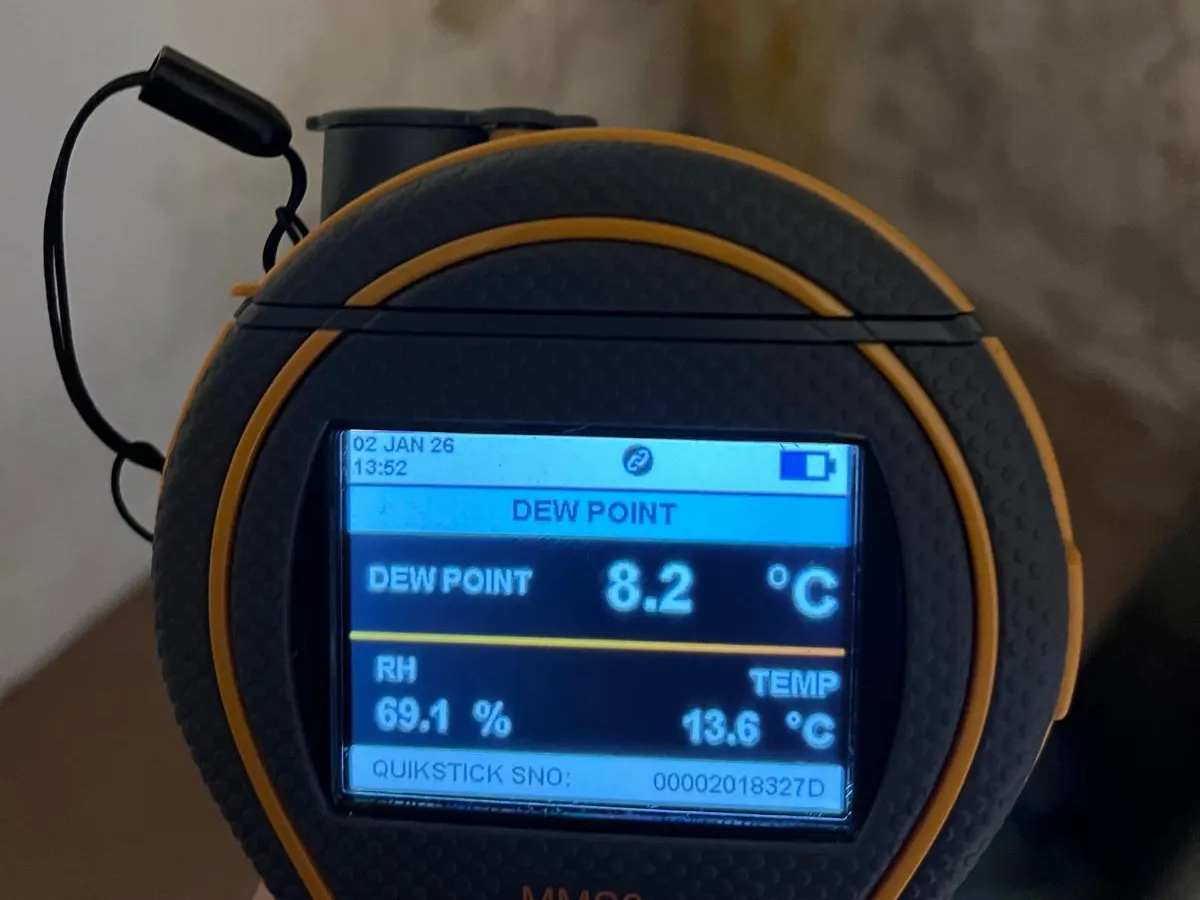
A Simply Filtered mould survey is a non-invasive assessment of a home with mould, anywhere in London inside the M25. Duncan Ridley measures relative humidity, dew point, surface temperatures and moisture levels to identify where moisture is building up and what is most likely driving it, whether condensation, a leak or damp coming through the building fabric. You then get a written report setting out the findings and practical recommendations to bring it under control.
It's about the cause, not the mould you can see. Cleaning and repainting deal with the surface. The survey identifies what's feeding it, so money is spent in the right place. Mould spores are present in every home, so no survey or treatment can promise it will never return. The aim is to remove the conditions that let it grow.
Book your mould surveyThe method
What does a mould survey involve?
A careful, non-invasive look at the rooms you're concerned about. No drilling, no lifting floors. Duncan looks at:
- Where the mould appears, how much moisture each room produces day to day, and how well it's being removed by extract fans, vents and heating
- Relative humidity (how much moisture the air is holding, compared with the most it could hold)
- Dew point, to work out which surfaces are cold enough for moisture to settle on
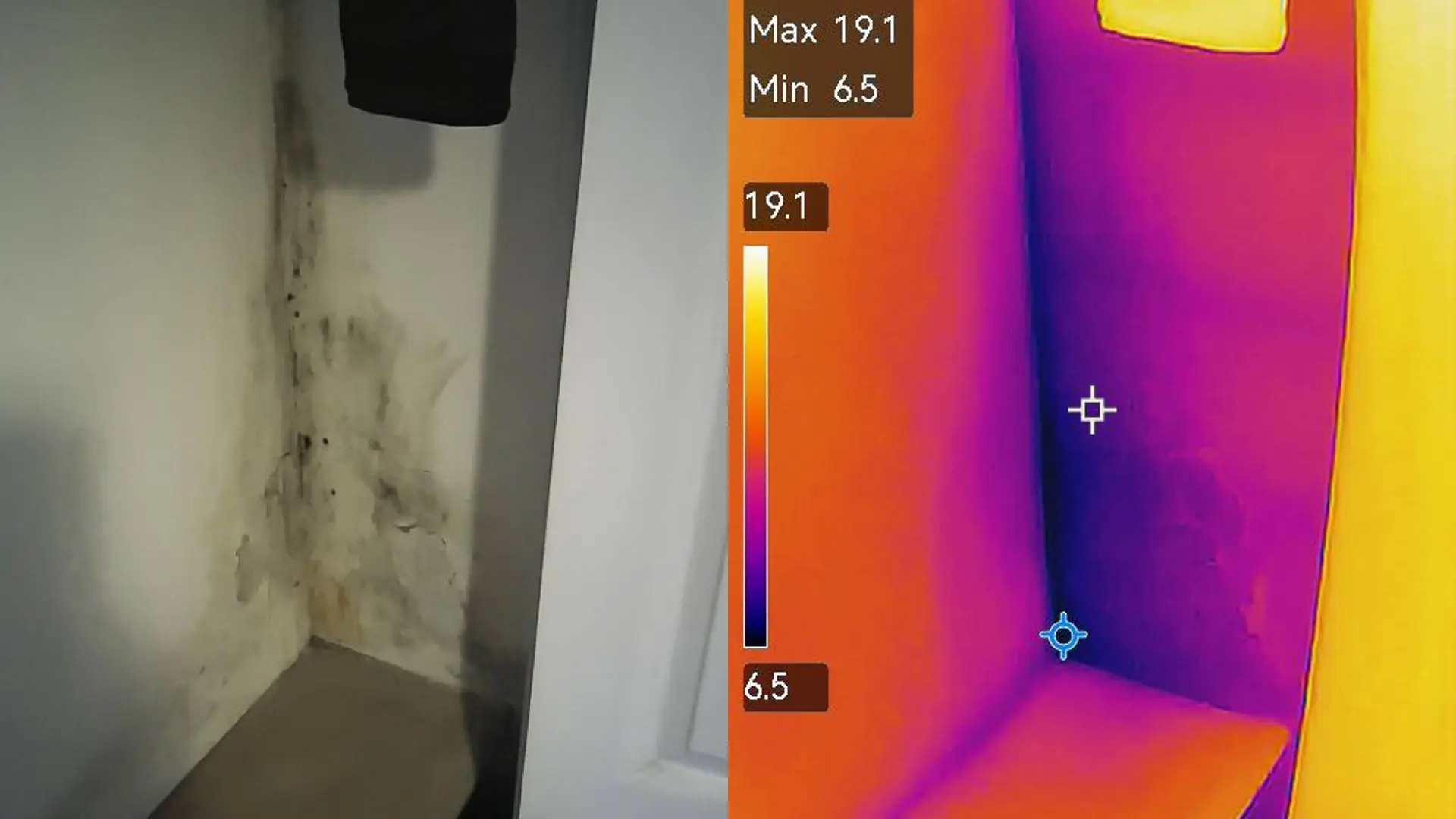
- Surface temperatures on walls, ceilings, corners and window reveals, to find cold spots
Because the survey is non-invasive, it can't see inside walls, under floors or into areas that weren't inspected. If the readings point to a hidden problem, the report will say so and recommend what further investigation is needed. We can arrange more invasive surveys should the need arise.
How much does a mould survey cost?
A mould survey includes the visit and your written report. The price depends on your home. Send the form for a free quote, with the exact price and what's included, before anything is booked.
The equipment, used where it's appropriate
- Moisture meter and hygrometer
- Readings from walls and timber, plus the humidity and dew point of the air.
- Shows whether the moisture is in the air, in the wall, or both.
- Thermal imaging camera
- A camera that shows surface temperatures as colours.
- Cold spots you can't see become obvious, so the fix goes where the problem is.
- Anemometer
- A meter that measures airflow.
- Shows whether your extractor fans are actually moving enough air.
- Salts testing
- A check for salts left by moisture moving through a wall.
- Helps tell rising damp apart from other damp, so a suspected case goes to the right specialist.
What it finds
What can a mould survey identify?
Most mould comes down to a few causes, and often more than one is at work. The survey helps identify which apply in your home, because the right approach is different for each.
Condensation
Moisture from everyday life settling on cold surfaces. The most common cause, usually addressed through a combination of ventilation, heating and insulation.
Why mould keeps coming backCold spots and cold bridges
Patches of wall or ceiling that run colder than the rest, so moisture settles there first.
Why mould grows in the same placeVentilation that isn't working
Extractor fans that don't move enough air, blocked trickle vents, or rooms with nowhere for moisture to go.
Ventilation adviceSomething that isn't condensation
Signs of a leak, or damp getting in from outside or below. If the readings point this way, Duncan will say so in the report and recommend the type of specialist to investigate further.
Mould survey or damp survey?
Your report ties each cause to a practical fix, so you don't pay for work you don't need.
What's in the reportWhen you need one
Signs you need a mould survey
If any of these sound like your home, the mould has a cause that cleaning won't reach:
- “I've cleaned and repainted, and the mould's back”
- “I wipe the windows every morning”
- “There's a musty smell that never quite goes”
- “The black spots keep coming back in the same corners”
- “I've tried mould spray, a dehumidifier and opening windows”
- “My tenant has reported mould and I need an independent answer”
- “I've been quoted for damp-proofing and want to know the cause first”
- “I'm buying a home with mould and want to know what it means”
What happens next
What happens, step by step
Send the form
About 2 minutes. Tell us what's going on in your own words.
Get your free quote
You get the price and what's included. No obligation to go ahead.
The visit
If you're happy with the quote, Duncan visits at a time that suits you, looks at the mould and takes the readings.
Your report
The cause and what to do next, with no obligation to use anyone we recommend.
What's in a mould survey report?
Your written report covers every room you're worried about, in plain English:
- Your recorded readings: relative humidity, dew point and surface temperatures
- Photographs, and thermal images where they're taken, so you can see the cold spots
- The root cause of the mould
- Practical recommendations and prevention advice, usually centred on ventilation

Mould survey or damp survey?
Is a mould survey the same as a damp survey?
Not quite. A mould survey finds out why mould is growing, which in most homes means condensation, and what it will take to deal with it.
A mould survey
- Finds out why mould is growing in your home
- In most homes, that means condensation
- Measures humidity, dew point and surface temperatures
- Sets out what it will take to deal with it
A damp survey
- Usually focuses on the building itself
- Looks for rising or penetrating damp
- Recommends how to treat it
In Duncan's experience rising damp gets diagnosed far more often than it's actually there, and the GOV.UK guidance on damp and mould also says it's often misdiagnosed.
When you need someone else
What a mould survey doesn't cover
If you think you've got a leak or rising damp, you need a specialist, not a mould survey. We'll tell you who to call. Knowing where a survey stops saves you paying for the wrong one.
- Finding leaks
- A leak detection company is who you need.
- Structural problems
- We'll point you to the right specialist.
- Building and ventilation work
- A trusted third party can do it, or you can use your own contractor.
- Health questions
- A survey measures your home, not your health. Speak to your GP about symptoms.
Who carries out your survey
Image: Duncan Ridley of Simply Filtered taking readings on a survey
Duncan Ridley
Founder, Simply Filtered
Duncan spent 18 years as a technical advisor in the heating industry, after a long career in construction and heating systems, and works in structural drying, flood remediation and building fabric diagnostics. He carries out every survey and writes every report himself, so you can ask him anything about yours.
- IICRC
- Water Damage Restoration Technician
- Dewpoint Professional
- Mould Remediation
Where we survey
Anywhere in London inside the M25, from a west London base, including:
- Ealing
- Fulham
- Wandsworth
- Chiswick
- Notting Hill
- Kensington
- Chelsea
- Hammersmith
- Shepherd's Bush
- Maida Vale
- Kilburn
- Camden
Questions
Mould survey questions
Will you try to sell me work?
No. Building, repair and ventilation work aren't part of the service, so there's nothing to sell you beyond the survey.
If your plan does need work, you're free to use anyone you like, with no obligation to use anyone we recommend.
Does a mould survey include getting rid of the mould?
No. The survey finds the cause and sets out the plan. If the plan needs ventilation or building work, a trusted third party can do it, or you can use your own contractor.
Is a mould survey worth it for a landlord?
If your tenant has reported mould and you're not sure what's causing it, yes. You get an independent record of what was measured and what's proportionate to do, which you can keep on file and share with your tenant.
Who pays for a mould survey?
Whoever books it. That's usually the homeowner, or the landlord or letting agent when a tenant reports mould. Tenants can also book a survey themselves, to get an independent report they can share with their landlord. See mould surveys for landlords or independent reports for tenants.
Is a mould survey the same as a homebuyer survey?
No, and it's not a replacement for a RICS survey. A mould survey focuses on the mould and condensation in the home: what's causing it and what it will take to deal with it.
What happens after the survey?
You get your written report, and you're free to use it however you like: with a contractor you choose, with your landlord or tenant, or to change how the rooms are used. There's no obligation to use anyone we recommend.
Next step
Find out what's causing your mould.
Your enquiry takes about 2 minutes, or you can send a WhatsApp message instead. You're under no obligation to use anyone we recommend.
WhatsApp usOr call 07366 199261